
Guide
Why Timber Veneer Shows Up in Almost Every Joinery Project We Build
From a curved reception bench to a bathroom vanity, timber veneer turns up in almost every joinery project we build. Here's what it's actually doing there.
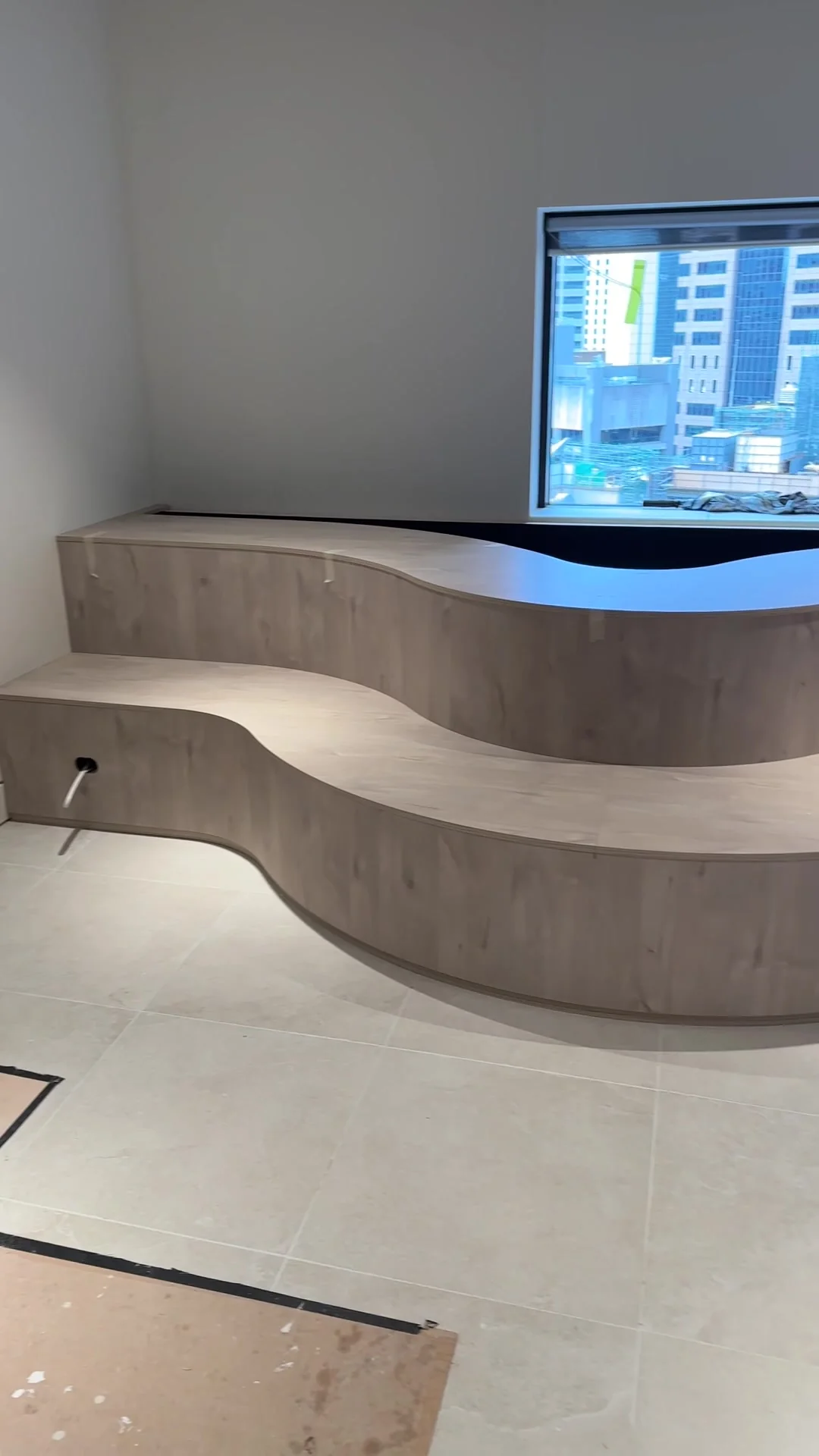
Look back across almost any joinery project we've delivered — commercial or residential — and timber veneer is probably in it somewhere. Not because it's the only option, but because it keeps solving the same problem: a consistent, warm, real-timber look across a large run of cabinetry, without the cost, weight and movement issues that come with building the same piece out of solid timber.
Reception and feature joinery is where it earns its keep most visibly. The curved reception bench in our Potts Point commercial fitout needed to read as one continuous sculpted form rather than a series of joined panels — veneer lets a curved substrate carry a convincing, uniform timber face across that whole sweep. We used the same approach for the curved feature bench in a Sydney CBD lift lobby refurbishment, where it sits beneath a window with a skyline outlook. See our commercial fitouts page for how joinery like this fits into a broader fitout scope.
Kitchens and breakout spaces lean on it for a different reason: consistency over a lot of cabinetry. A full kitchen run has a lot of doors, panels and end-panels that all need to match — veneer keeps the grain and tone consistent across every piece in a way that's much harder to guarantee with solid timber sourced panel by panel. Our Sydney CBD breakout kitchen and our Bondi kitchen and living renovation both used it for exactly this reason — see our office fitouts and residential renovations pages for the fuller scope of each.
On the residential side, it's just as common in wardrobes and bathrooms as it is in kitchens. Our wardrobe and kitchen joinery in Coogee used a single consistent timber-veneer finish right across the wardrobes, bathroom shelving and pantry, so the whole home reads as one considered material palette rather than a different finish in every room. The bathroom vanities in our Bondi Junction kitchen and bathroom renovation and our Balmain bathroom renovation both use it the same way — a warm, deliberately quiet finish that doesn't compete with the stone or tiling around it.
It isn't always the right call. In high-moisture areas the edges and joins need proper sealing and detailing, or they're the first thing to fail — and in a few high-abuse commercial applications, a laminate or solid-surface finish will outlast a veneer under constant everyday wear. The projects above all used timber veneer because it was solving something specific — consistency, warmth, a continuous curved form — not because it's the default finish on every sample board.
If you're working out which finish actually makes sense for your joinery — commercial or residential — get in touch, or see our custom joinery page for the fuller picture of what we build.
More From the Blog
Related Reading
Guide
Planning a Commercial Fitout? Start With These Questions
Before you get a fitout company involved, a handful of honest answers to these questions will save you time, budget and stress once construction starts.
Guide
Replacing a Shopfront? Here's What the Process Actually Involves
A new glass-and-aluminium shopfront looks simple from the footpath. Here's what actually happens between the old one coming down and the new one opening for trade.